
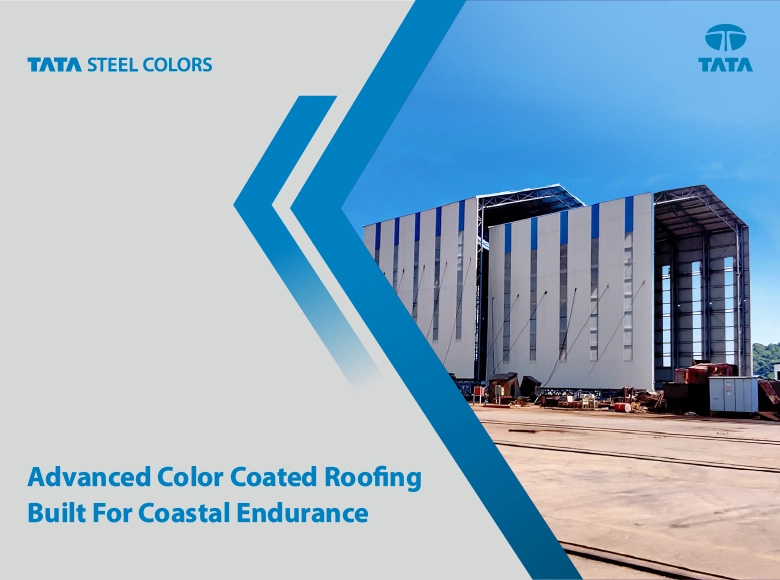
India’s coastline extends over 7,500 kilometers and supports some of the country’s most critical infrastructure assets, including ports, power plants, desalination facilities, industrial corridors, logistics terminals, and rapidly expanding coastal urban developments. These assets operate in environments characterized by persistent humidity, salt-laden air, strong winds, and high solar exposure, creating conditions where corrosion becomes a continuous design and asset management challenge with direct implications for structural integrity, service life, and long-term maintenance planning.
The choice of material for roofs, façades, and external cladding plays a decisive role in determining how well coastal infrastructure withstands these conditions. Corrosion-resistant steel coils, engineered through advanced metallic-coated steel technology and high-performance color-coated systems, have become a critical solution for protecting coastal assets over extended service periods.
- Corrosion rates in coastal zones can be 3–5 times higher than in inland industrial areas
- Salt deposition combined with humidity can reduce the life of inadequately protected steel by 40–60%
- Cyclic wetting and drying create ideal conditions for corrosion initiation and propagation
Understanding corrosion in coastal environments
Corrosion in coastal zones is driven primarily by chloride ions present in salt spray and airborne marine aerosols. These chlorides accelerate electrochemical reactions on metal surfaces, leading to rapid material degradation if protection systems are inadequate.
Unlike inland environments, coastal areas experience continuous cycles of wetting and drying. Salt deposits accumulate on surfaces and retain moisture, creating ideal conditions for corrosion initiation and propagation. Roofing and wall systems in coastal regions are therefore exposed to higher corrosion rates than those in non-marine locations.
For coastal industrial roofing and large infrastructure projects, this makes conventional steel products insufficient unless they are specifically engineered for high-salt environment steel applications.
Role of corrosion-resistant steel coils
Corrosion-resistant steel coils form the foundation of durable coastal construction. These coils are manufactured using metallic-coated steel technology, where a protective alloy coating is applied to the steel substrate before forming. This metallic layer acts as a sacrificial and barrier protection system, shielding the base steel from direct exposure to corrosive elements.
In marine and coastal environments, advanced aluminum-zinc alloy coatings are commonly used because they provide superior resistance to chloride-induced corrosion compared to basic zinc coatings. The aluminum component offers long-term barrier protection, while zinc provides sacrificial protection at cut edges and scratches.
This combination is particularly effective for high-salt environment steel applications, where surface damage and edge exposure are unavoidable over time.
Enhancing protection with color-coated systems
While metallic coatings protect the steel substrate, corrosion-resistant color-coated steel adds an additional layer of defense. Color-coated systems consist of a carefully engineered multi-layer structure that includes surface pretreatment, primer layers, and a durable topcoat.
For coastal infrastructure, these coatings serve several critical functions. They reduce direct contact between the metallic coating and the environment, slow down moisture penetration, and resist ultraviolet degradation caused by constant sun exposure. Together, these features significantly extend the time before corrosion can initiate.
Color-coated roofing sheets manufactured from corrosion-resistant steel coils are therefore widely used in marine-grade steel roofing material applications, where both durability and surface stability are essential.
Performance advantages for coastal industrial roofing
Coastal industrial roofing systems must perform reliably under extreme conditions while supporting large spans and continuous operations. Corrosion-resistant steel coils provide predictable performance by maintaining coating integrity even in environments with high salt deposition and wind-driven rain.
One key advantage is reduced underfilm corrosion. High-quality coatings limit the spread of corrosion beneath the paint layer, preventing localized damage from escalating into widespread roof failure. This is particularly important for large industrial roofs where access for repairs is difficult and operational disruption is costly.
Long-term maintenance and lifecycle benefits
Maintenance is one of the most significant cost drivers for coastal infrastructure. Roofs and façades that corrode prematurely require frequent inspection, patch repairs, repainting, or even early replacement. In marine environments, these activities are expensive and also logistically complex.
By using corrosion-resistant steel coils with high-performance color-coated systems, infrastructure owners can significantly reduce maintenance frequency. The extended durability of these materials supports longer inspection intervals, fewer corrective interventions, and lower lifecycle costs.
For large coastal facilities, this improvement in lifecycle performance translates into better asset predictability and reduced operational risk.
Supporting architectural and functional requirements
Modern coastal infrastructure often combines industrial function with architectural visibility. Ports, coastal commercial campuses, and public infrastructure are highly exposed and form part of the regional visual identity. In such cases, corrosion protection must be achieved without compromising appearance.
Color-coated steel systems provide consistent surface finish and long-term color stability, supporting aesthetic steel roofing applications even in harsh marine environments. This makes them suitable for projects that demand both performance and visual consistency over time.
Adaptability to complex coastal applications
Coastal infrastructure projects are rarely static. Expansion, retrofitting, and integration of new systems such as solar installations or service equipment are common. Steel coils engineered for corrosion resistance offer a stable, predictable substrate for such adaptations.
Marine-grade steel roofing material manufactured from advanced coils supports reliable fastening, compatibility with accessories, and controlled behavior under load, reducing the risk of corrosion-related complications during future modifications.
Selecting the right steel coil system for coastal use
Not all steel products are suitable for coastal environments. Effective corrosion protection depends on selecting the appropriate combination of metallic coating weight, alloy composition, and color-coated system based on site exposure severity.
For high-risk coastal zones, heavier metallic coatings combined with premium color-coated systems provide the highest level of protection. Proper detailing, drainage design, and maintenance planning further enhance system performance.
Specifying corrosion-resistant steel coils as part of an integrated roofing or cladding solution ensures that coastal infrastructure is equipped to handle long-term exposure without premature failure.
Conclusion: Building durable coastal infrastructure through material choice
At Tata Steel Colors, long-term coastal performance begins with the right steel coil technology, supported by advanced metallic coatings, high-performance color-coated systems, and application-specific design understanding. In aggressive marine environments, material selection plays a defining role in determining durability, maintenance cycles, and lifecycle value.
By making informed material choices early in the design and specification stage, infrastructure owners can extend asset life, reduce long-term maintenance burden, and ensure consistent structural and aesthetic performance across decades of operation, even in the most demanding coastal conditions.
Get in touch with us to know more about the role steel coils play in protecting coastal infrastructure.