
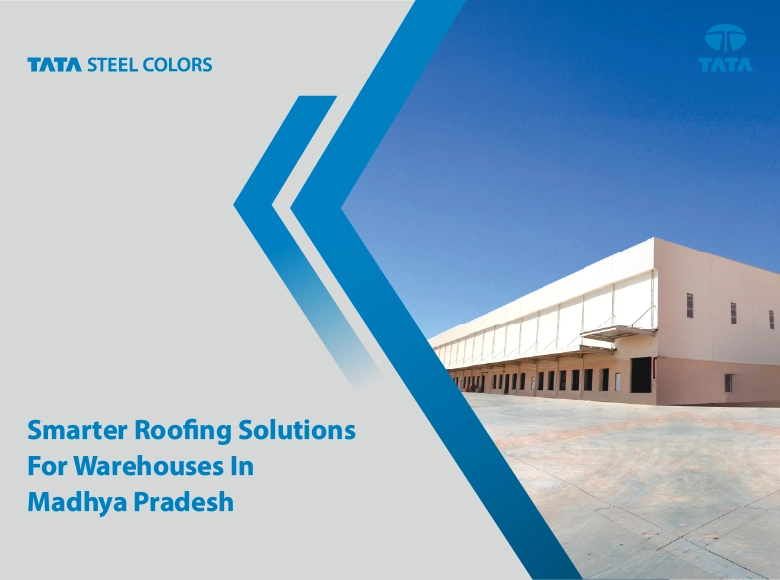
Madhya Pradesh is rapidly emerging as a strategic warehousing and logistics destination in central India. Its geographic advantage, improving highway connectivity, proximity to major consumption centers, and policy support have led to the development of large logistics parks, distribution centers, and storage facilities across Indore, Bhopal, Pithampur, Dewas, and surrounding industrial belts. As warehousing scales up in size and complexity, the design of the building’s roof and wall cladding systems plays a decisive role in optimizing storage efficiency, operational reliability, and long-term asset performance.
In this context, roof and wall cladding solutions are no longer viewed as basic enclosures. They are integral building systems that directly influence internal usable volume, protection of goods, energy behavior, and maintenance efficiency.
Warehousing requirements in Madhya Pradesh’s logistics landscape
Warehouses in Madhya Pradesh cater to diverse sectors including FMCG, automotive components, pharmaceuticals, agri-produce, and e-commerce fulfillment. These facilities often operate around the clock and handle high inventory turnover. Any compromise in environmental control, water tightness, or structural performance can lead to inventory damage and operational disruption.
Climatic conditions further amplify these requirements. Warehouses are exposed to intense summer heat, monsoon rainfall, dust-laden winds, and temperature variation. As a result, warehouse roofing and wall systems must deliver consistent performance across seasons while supporting large clear spans and high stacking heights.
Roofing solutions for high-volume storage efficiency
Advanced roofing solutions are central to maximizing usable storage space. Modern warehouses require column-free interiors and higher clear heights to support automated racking systems and vertical storage. Roofing systems designed for long spans enable wider bay spacing and reduce internal obstructions, directly improving storage density.
Leak-proof industrial roofs are especially critical in warehousing environments. Even minor roof leakage can damage stored goods, disrupt operations, and increase insurance exposure. High-performance roofing solutions are engineered to manage heavy rainfall through optimized drainage paths, controlled overlaps, and minimized roof penetrations. This ensures reliable weather protection during monsoon conditions common across central India.
Thermal behavior is another important consideration. Large roof surfaces absorb significant solar heat, increasing internal temperatures and affecting stored materials. Well-designed roofing solutions reduce heat ingress, supporting more stable internal conditions and lowering ventilation or cooling loads. This contributes to better preservation of goods and improved working conditions for warehouse personnel.
Wall cladding as a driver of space optimization
While roofing defines vertical capacity, wall cladding determines how effectively the storage envelope performs at ground and façade levels. Storage facility wall panels are designed to provide structural stability while maintaining a slim profile, allowing maximum internal floor area utilization.
Modern wall cladding systems support tall wall heights required for high-rack warehouses without compromising strength. They are engineered to withstand lateral wind loads, impact from material handling equipment, and long-term environmental exposure. For logistics parks and distribution hubs, this durability reduces the risk of façade damage and unplanned maintenance.
Wall cladding also plays a vital role in controlling dust ingress and moisture penetration. In facilities handling sensitive goods, consistent internal cleanliness is essential. Properly detailed wall systems minimize gaps, prevent water seepage, and support controlled internal environments.
Integrated roof and wall cladding solutions for logistics facilities
The most efficient warehousing facilities adopt roof and wall cladding solutions as an integrated building system rather than independent elements. When roofing solutions and wall cladding are designed to work together, junctions perform better, drainage continuity improves, and overall reliability of the roof and wall cladding system increases.
Integrated systems reduce weak points at roof-to-wall interfaces, which are common sources of leakage and thermal loss. This integrated approach is particularly valuable in large logistics parks where repetitive building modules must deliver consistent performance across multiple units. For logistics park cladding solutions, system integration also improves construction speed and quality consistency, enabling faster commissioning of warehouse assets.
Premium roofing solutions and lifecycle efficiency in India
Premium roofing solutions in India are increasingly evaluated based on lifecycle performance rather than upfront cost alone. Warehouses are long-term infrastructure assets, and frequent repairs or roof replacement can disrupt logistics operations and increase operating expenses.
High-performance roofing systems offer predictable service life through corrosion-resistant steel substrates and durable coating technologies. These features slow down degradation caused by moisture, dust accumulation, and thermal cycling. As a result, inspection intervals are extended and maintenance costs reduced.
Learning from high-density logistics corridors
Although the focus is on Madhya Pradesh, insights from mature warehousing markets such as warehouse roofing in Thane and commercial warehouse construction in Mumbai provide useful benchmarks. These regions have demonstrated the value of engineered roofing and wall cladding systems in managing high rainfall, heavy usage, and tight operational schedules. Applying similar performance-led design principles in Madhya Pradesh enables developers to future-proof warehouses as logistics demand continues to grow across central India.
Durability and low maintenance as operational priorities
Warehouses typically operate with minimal downtime, making maintenance access both difficult and costly. Roof and wall cladding solutions designed for durability reduce the need for frequent interventions. Corrosion-resistant materials, robust fixing methods, and engineered detailing protect against premature failure. Low-maintenance systems are particularly important for large logistics parks where roof access involves safety protocols and operational planning. By minimizing maintenance frequency, facilities can maintain continuous operations while controlling long-term costs.
Supporting scalability and future expansion
Warehousing demand in Madhya Pradesh is expected to expand as supply chains become more centralized and technology-driven. Roof and wall cladding solutions that support modular construction allow warehouses to be expanded or modified with minimal disruption. Individual roofing sheets or wall panels can be extended or replaced without dismantling large sections of the building envelope. This flexibility supports phased expansion and adaptation to changing storage requirements.
Conclusion: Building an efficient warehouse infrastructure in Madhya Pradesh
As Madhya Pradesh strengthens its position as a logistics and warehousing hub, optimizing storage space and operational efficiency becomes a strategic priority. Advanced roofing solutions and engineered wall cladding systems enable warehouses to achieve higher clear heights, improved protection of goods, and long-term durability.
By adopting integrated roof and wall cladding solutions, warehouse developers and operators can create facilities that perform reliably under demanding climatic conditions, reduce maintenance overheads, and support scalable logistics operations.
For more details, please get in touch with our team. We would love to explain how our roof and wall cladding solutions can help build resilient warehouse infrastructure in Madhya Pradesh.