
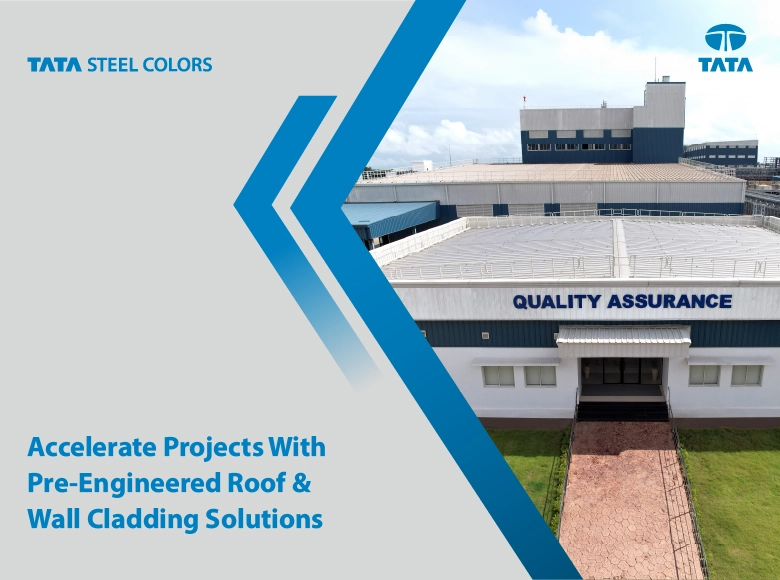
In today’s industrial, commercial, and infrastructure projects, speed of construction has become as critical as structural performance and durability. Delayed project timelines directly affect capital deployment, revenue generation, and operational planning. As a result, developers and EPC teams are increasingly adopting pre-engineered roof and wall cladding solutions to compress construction schedules while maintaining predictable quality and long-term performance.
Pre-engineered building materials shift a significant portion of construction effort away from the site and into controlled manufacturing environments. When applied to roof systems, wall cladding, and supporting elements such as decking, this approach enables faster installation, reduced site dependencies, and more reliable project delivery.
Why speed matters in modern construction projects
Large industrial plants, warehouses, logistics parks, commercial campuses, and infrastructure facilities are often developed under tight timelines. Any delay in roof closure or façade completion exposes projects to weather risks, labor inefficiencies, and cascading schedule overruns. Roof and wall cladding systems sit on the critical path of construction. Until the building is weather-tight, internal works such as flooring, services, equipment installation, and finishes struggle to progress at full pace. This makes fast installation roofing and quick construction wall panels strategically important rather than optional upgrades.
What defines pre-engineered roof and wall cladding solutions
Pre-engineered roof and wall cladding solutions are designed, manufactured, and supplied as complete systems rather than as loose, site-assembled components. Profiles, lengths, fixings, accessories, and interfaces are engineered in advance to suit structural layouts and performance requirements.
Unlike conventional construction methods that rely heavily on on-site fabrication and adjustment, pre-engineered systems arrive ready for installation. This reduces variability, rework, and dependency on skilled site labor for cutting, welding, or surface finishing.
For large projects, this system-based approach dramatically improves construction speed and predictability.
Faster installation through engineered roof systems
Roof systems are among the most time-sensitive components of any building. Pre-engineered roof systems enable rapid installation by using long-length sheets, standardized fixing methods, and predefined detailing.
Fast installation roofing is achieved through:
- Reduced number of roof joints and overlaps
- Engineered fixing layouts that simplify alignment
- Compatibility between roofing sheets and accessories
With fewer components to assemble on site, crews can cover larger roof areas in shorter timeframes. This is particularly beneficial for large-span buildings such as factories, warehouses, and transit facilities where roof area directly impacts construction duration.
Accelerating enclosure with quick construction wall panels
Wall cladding plays a critical role in achieving an early building enclosure. Pre-engineered wall cladding systems use quick construction wall panels that are designed for consistent fit, alignment, and weather-tight performance.
These panels are manufactured to precise dimensions, reducing the need for on-site cutting and adjustment. As a result, wall installation progresses faster and with fewer quality deviations.
Rapid wall closure allows interior works to begin earlier, improving overall project sequencing and reducing exposure to weather delays.
Reduced on-site dependencies and parallel work execution
One of the key advantages of pre-engineered building materials is the ability to decouple manufacturing from site readiness. While foundations and structural frameworks are being constructed on site, roof and wall cladding components can be fabricated simultaneously in manufacturing facilities.
This parallel execution shortens overall project timelines and reduces idle periods between construction phases. Once the structure is ready, roof and wall cladding systems can be installed immediately, keeping momentum high. Reduced on-site fabrication also lowers dependence on weather conditions, which often disrupt conventional construction schedules.
Role of steel decking sheets in speeding up construction
Steel decking sheets contribute significantly to construction speed, especially in multi-level industrial and commercial buildings. These sheets act as permanent formwork for floors and roofs, eliminating the need for traditional shuttering and propping.
Pre-engineered steel decking sheets are supplied in standardized profiles and lengths, allowing quick placement and fixing. Once installed, they enable immediate progression to reinforcement placement and concrete pouring.
This approach reduces labor intensity and accelerates slab cycles, which is particularly valuable in time-sensitive projects.
Composite floor decking systems for structural efficiency
Composite floor decking systems further enhance construction speed by integrating steel decking with concrete slabs to form composite structural elements. These systems reduce slab thickness, material consumption, and curing time.
Because the decking acts as both formwork and reinforcement support, fewer construction steps are required. This simplifies sequencing and enables faster floor-to-floor progression.
In projects where speed and structural efficiency must go hand in hand, composite floor decking systems offer measurable time savings.
Quality, consistency and reduced rework
Pre-engineered roof and wall cladding solutions improve construction speed while also enhancing quality consistency. Manufacturing under controlled conditions ensures uniform dimensions, coating integrity, and component compatibility. This reduces common site issues such as misalignment, uneven joints, and inconsistent fixing patterns. Lower rework rates directly translate into time savings, cost control, and smoother project execution.
Improved safety and site management
Faster construction achieved through pre-engineered systems also improves site safety. Reduced on-site cutting, welding, and material handling lowers the risk of accidents and improves working conditions. Shorter installation durations mean fewer man-hours spent at height during roofing and wall cladding activities. This contributes to safer project execution and easier compliance with safety protocols.
From a project management perspective, predictable installation timelines simplify coordination between trades and reduce congestion on site.
Supporting scalability and repeatability across projects
Developers managing multiple facilities or phased expansions benefit significantly from pre-engineered roof systems and wall cladding solutions. Standardized designs allow repeatable execution across sites, improving learning curves and reducing mobilization time. Once installation teams are familiar with a system, subsequent projects progress even faster. This scalability is particularly valuable in logistics parks, industrial campuses, and infrastructure programs with repetitive building typologies.
Conclusion: Building faster without compromising performance
Speeding up construction is about adopting smarter building systems that shift complexity away from the site and into engineered, repeatable solutions. Pre-engineered roof and wall cladding solutions enable faster installation, predictable quality, and efficient sequencing across a wide range of projects.
When combined with steel decking sheets and composite floor decking systems, they significantly reduce construction timelines while supporting durable, high-performance buildings.For developers and EPC teams seeking to deliver projects on time and at scale, pre-engineered roof and wall cladding solutions provide a clear path to faster, safer, and more efficient construction.
For more details, please get in touch with our team.