
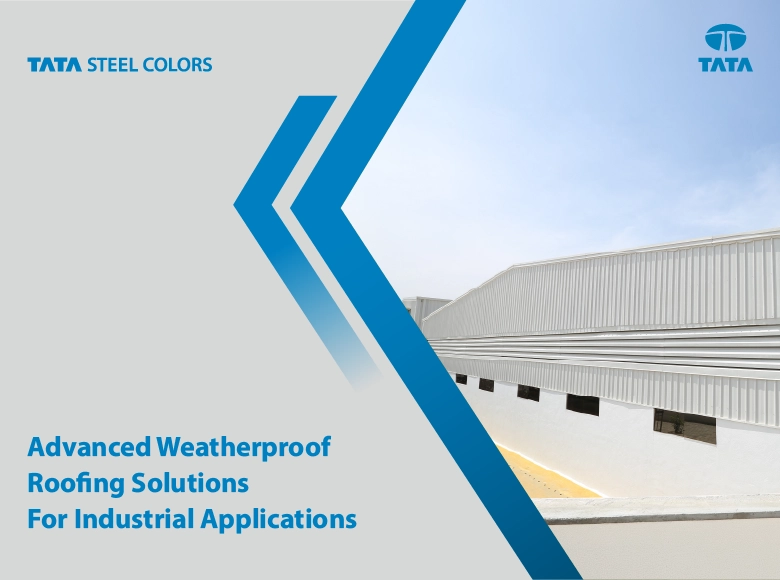
Water leakage remains one of the most persistent and costly challenges in large industrial sheds. Whether it is a manufacturing unit, warehouse, logistics shed, or processing facility, roof or wall leakage can disrupt operations, damage inventory and equipment, and increase long-term maintenance costs. In regions with heavy rainfall or prolonged monsoon exposure, leak prevention becomes a critical design priority rather than a post-construction concern.
Preventing factory roof leaks requires a system-based approach that integrates roofing solutions, industrial wall cladding solutions, drainage design, and installation detailing into a weather-tight building envelope. In this blog, we will dive into the details of how superior roof and wall cladding solutions protect industrial sheds against leaks.
Why large industrial sheds are prone to leakage
Large industrial sheds differ from smaller buildings in both scale and complexity. Expansive roof areas generate high volumes of rainwater runoff, while long sheet lengths and multiple structural interfaces increase the risk of leakage if detailing is inadequate.
Common leakage causes include:
- Improperly designed roof slopes and drainage paths
- Inadequate detailing at roof-to-wall junctions
- Excessive roof penetrations for services and equipment
- Fastener-related failures and seal degradation
- Thermal movement that stresses joints and overlaps
In heavy rain areas, even minor design or installation gaps can lead to recurring water ingress. This is why waterproof industrial roofing must be planned holistically rather than treated as a surface-level solution.
Role of roofing solutions in leak prevention
Effective roofing solutions form the first line of defense against water ingress. For large industrial sheds, the roof system must be designed to manage both water volume and wind-driven rain.
Modern roofing solutions emphasize:
- Continuous sheet coverage with minimal joints
- Controlled overlaps to prevent capillary action
- Fixing systems designed to withstand wind uplift and thermal movement
Waterproof industrial roofing is achieved when roofing sheets, fixings, sealants, and accessories function as a unified system. Systems that allow roofing sheets to move independently under thermal expansion reduce stress on joints and significantly lower the risk of long-term leakage.
In heavy rain areas, selecting the best roofing for heavy rain areas also involves ensuring sufficient roof pitch and compatibility with high-capacity drainage components.
Importance of industrial wall cladding solutions
While roof leakage is often the primary concern, wall cladding plays an equally important role in leak prevention. Wind-driven rain frequently enters industrial sheds through wall systems, especially at junctions, laps, and service openings.
Industrial wall cladding solutions designed for weather-tight performance provide:
- Robust resistance to lateral rain penetration
- Secure panel engagement to prevent water tracking
- Durable detailing around openings and service penetrations
Properly designed wall cladding also protects internal spaces from splashback and runoff at ground level, which is particularly important in facilities with heavy vehicle movement or external washdown areas.
Weather-tight cladding systems as an integrated approach
Leak prevention is most effective when roofing and wall systems are treated as a single, coordinated solution. Weather-tight cladding systems focus on the performance of the entire building shell rather than individual components.
Key benefits of system-based cladding include:
- Improved sealing at roof-to-wall interfaces
- Consistent material behavior across large surfaces
- Reduced dependence on secondary sealants
By integrating roofing solutions and wall cladding into one coordinated system, designers can eliminate weak points that commonly become leakage paths over time.
Rainwater drainage for sheds: design considerations
Rainwater drainage for sheds must be designed to handle peak rainfall intensity rather than average conditions.
Critical drainage considerations include:
- Adequate roof slope to prevent ponding
- Properly sized gutters and downpipes
- Secure gutter fixing to prevent overflow during heavy rain
- Clear drainage paths free from obstructions
Poor drainage leads to water accumulation, which increases hydrostatic pressure at joints and penetrations. Over time, this accelerates seal failure and leakage. Effective drainage design is therefore a core component of waterproof industrial roofing.
Managing penetrations and service interfaces
Industrial sheds typically require roof penetrations for ventilation, lighting, exhaust systems, and fire safety equipment. Each penetration introduces a potential leakage point without proper measures.
Superior roofing solutions minimize the number of penetrations and use standardized flashing and sealing systems where penetrations are unavoidable. Factory roof leaks often originate from poorly executed service interfaces rather than from the roofing sheets themselves.
Coordinating roofing design with mechanical and electrical layouts early in the project helps reduce ad-hoc penetrations and improves long-term water tightness.
Installation quality and detailing discipline
Even the best materials can fail if installation quality is inconsistent. Large industrial sheds require disciplined installation practices due to the scale of work and repetition involved.
Key installation factors that influence leak prevention include:
- Accurate alignment of roofing sheets and wall panels
- Correct torque and placement of fixings
- Proper sealing at laps, joints, and interfaces
- Strict adherence to system-specific installation guidelines
Weather-tight cladding systems rely on precision and consistency. Small deviations, when repeated across large areas, can result in widespread leakage over time.
Durability and maintenance considerations
Preventing leaks is closely linked to long-term durability. Roofing and wall cladding systems that resist corrosion, UV degradation, and seal aging maintain their weather-tight performance for longer periods. Low-maintenance roofing solutions reduce the need for frequent inspections and reactive repairs, which are both costly and disruptive in industrial environments. Durable materials and system-based designs help ensure that waterproof industrial roofing performance is sustained throughout the building’s service life.
Designing for heavy rain and regional climate
In regions that experience intense monsoon rainfall, selecting the best roofing for heavy rain areas requires careful consideration of local climate data. Roof pitch, drainage capacity, and cladding system selection must be tailored to site-specific conditions.
Factories located in flood-prone or coastal zones also need enhanced detailing at lower wall sections and interfaces to prevent water ingress during extreme weather events.
Conclusion: A system-based strategy for leak-free industrial sheds
Preventing leaks in large industrial sheds needs a comprehensive approach that integrates roofing solutions, industrial wall cladding solutions, rainwater drainage design, and disciplined installation practices.
Waterproof industrial roofing performs best when combined with weather-tight cladding systems that manage water flow, accommodate thermal movement, and minimize long-term maintenance risks. By focusing on system compatibility rather than individual components, industrial facilities can effectively prevent factory roof leaks, protect operations, and ensure long-term asset performance.
In demanding environments and heavy rain areas, investing in superior roof and wall cladding solutions is more than just a construction decision; it is a critical operational safeguard. For more details, please get in touch with our team.