
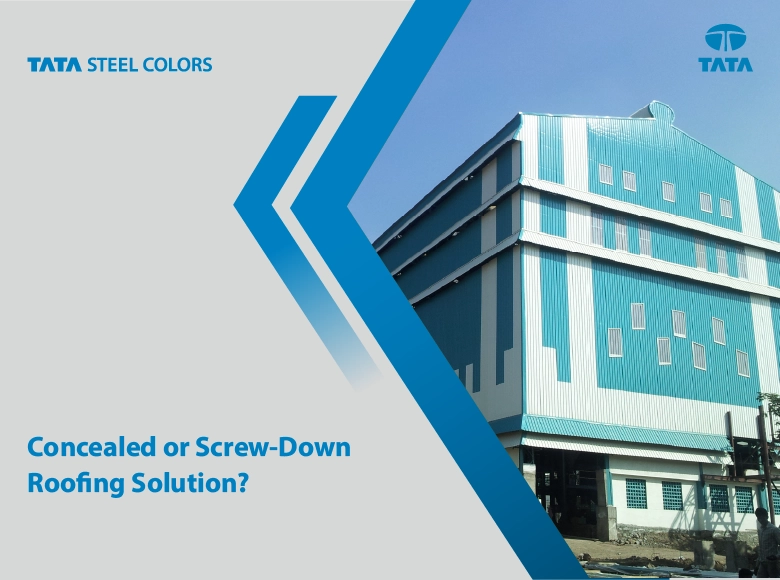
Selecting the right roof and wall cladding solutions is a critical decision in factory design. Roofing and wall systems influence weather protection as well as long-term durability, maintenance requirements, and operational reliability. Among the most common industrial roof installation types, concealed fixed systems and screw-down systems are often compared for factory applications.
While both systems are widely used, their performance characteristics differ significantly. Understanding these differences helps factory owners and project teams choose roofing solutions and wall cladding systems that align with operational needs, environmental exposure, and lifecycle expectations.
Understanding screw-down roof and wall cladding systems
Screw-down systems are among the most traditional industrial roof installation types. In these systems, roofing sheets and wall panels are fixed directly to the supporting structure using exposed fasteners. The fasteners pass through the sheet and are sealed using washers to prevent water ingress.
Screw-down roofing solutions are commonly selected for factories due to their straightforward installation process and lower initial material cost. The system is familiar to installers and can be deployed quickly on simple industrial structures.
However, because fasteners are exposed to the weather, they become a critical performance point over time. Temperature variation, wind movement, and prolonged exposure can cause fastener loosening or washer degradation, which may lead to leakage without regular monitoring.
Performance considerations of screw-down systems
In factory environments, screw-down systems can perform adequately when maintenance protocols are strictly followed. Periodic inspection and tightening of fasteners help maintain weather tightness. However, in large factories with expansive roof areas, this maintenance requirement can become operationally challenging.
Thermal movement is another factor. As roofing sheets expand and contract, stress is transferred directly to the fasteners. Over time, this movement can enlarge fastener holes, increasing the risk of leakage. For factories located in regions with high temperature variation or heavy rainfall, these risks must be carefully evaluated.
Screw-down systems are typically better suited for smaller spans or facilities where access for maintenance is relatively simple.
What are concealed fixed roofing systems
Concealed fixed roofing systems, often referred to as screwless roof sheets or standing seam systems, use clips or interlocking mechanisms to secure roofing sheets to the structure without exposed fasteners. The fixing points are hidden beneath the sheet profile, protecting them from direct environmental exposure.
In concealed systems, the roofing sheets are allowed to move independently of the structure, accommodating thermal expansion and contraction without stressing the fixing points. This design approach improves long-term performance and reduces maintenance requirements.
Concealed systems are increasingly specified in factories that demand leak-proof factory roofing and consistent performance over extended service life.
Concealed fix roofing benefits for factory applications
One of the primary concealed fix roofing benefits is improved weather resistance. Without exposed fasteners on the roof surface, the risk of water ingress through fixing points is significantly reduced. This makes concealed systems particularly effective for factories operating in high rainfall or high humidity environments.
Thermal movement is managed more effectively in concealed systems. The clip-based fixing mechanism allows roofing sheets to expand and contract freely, reducing stress concentration and minimizing the risk of fatigue-related failures.
From a durability perspective, concealed systems also reduce corrosion risk at fixing points, which are common failure zones in exposed fastener systems.
Leak-proof performance and operational reliability
Leak-proof factory roofing is a critical requirement for industrial facilities, especially those handling sensitive equipment, raw materials, or finished goods. Even minor roof leaks can disrupt production, damage inventory, and create safety hazards.
Concealed fixed systems provide superior leak resistance by eliminating exposed penetration points across the roof surface. Combined with continuous sheet lengths and controlled overlaps, these systems offer more predictable long-term weather tightness.
While screw-down systems can also be designed to be leak-resistant, their performance depends heavily on ongoing maintenance and installation quality.
Standing seam roof comparison: System behaviour over time
In a standing seam roof comparison, concealed systems consistently demonstrate better long-term performance under demanding conditions. Standing seam designs maintain continuous seams along the roof length, enhancing water-shedding capability and reducing vulnerability during heavy rainfall.
These systems also perform well under wind uplift forces, as the interlocking seams distribute loads across the roof assembly. This is particularly relevant for factories with large roof spans or those located in exposed industrial zones.
Screw-down systems, by contrast, rely on individual fasteners to resist uplift forces, making them more sensitive to installation precision and long-term fastener condition.
Wall cladding considerations: Matching roof performance
The choice between concealed and screw-down systems also extends to wall cladding. Wall cladding panels with exposed fasteners may be adequate for low-impact zones, but in factories with high dust levels, vibration, or chemical exposure, concealed fixing options offer improved durability.
Concealed wall cladding systems protect fixings from lateral weather exposure and accidental impact, maintaining façade integrity over time. This is especially important for factories where wall cladding is exposed to frequent material handling activity.
Selecting roof and wall cladding solutions as a coordinated system ensures consistent performance across the building envelope and reduces maintenance variability.
Installation complexity and cost considerations
From an installation perspective, screw-down systems are simpler and typically involve lower upfront cost. They may be suitable for factories with limited budgets or shorter design life expectations.
Concealed systems require greater installation precision and skilled workmanship. Initial costs are generally higher due to specialized components and installation requirements. However, these costs are often offset over time through reduced maintenance, fewer repairs, and longer service life.
Evaluating roofing solutions should therefore involve lifecycle cost analysis rather than upfront cost comparison alone.
Choosing the right solution for your factory
The decision between concealed and screw-down roof and wall cladding solutions depends on several factors:
- Factory size and roof span
- Environmental exposure and climate
- Sensitivity of operations to leakage
- Maintenance access and capability
- Expected service life of the facility
Factories with large spans, high operational sensitivity, and long-term usage requirements typically benefit more from concealed fixed systems. Smaller or less complex facilities may find screw-down systems adequate if maintenance is planned proactively.
Conclusion: Making an informed roofing decision
Both concealed and screw-down systems have a place in industrial construction. The key is aligning the roofing and wall cladding solution with the functional and operational priorities of the factory.
Concealed fix roofing benefits include superior leak resistance, better thermal movement management, and lower maintenance over time. Screw-down systems offer simplicity and cost efficiency but require diligent upkeep to maintain performance.
By understanding the differences between these industrial roof installation types and evaluating them through a lifecycle lens, factory owners can select roof and wall cladding solutions that deliver durability, reliability, and long-term value.
For more details, please get in touch with our team.