
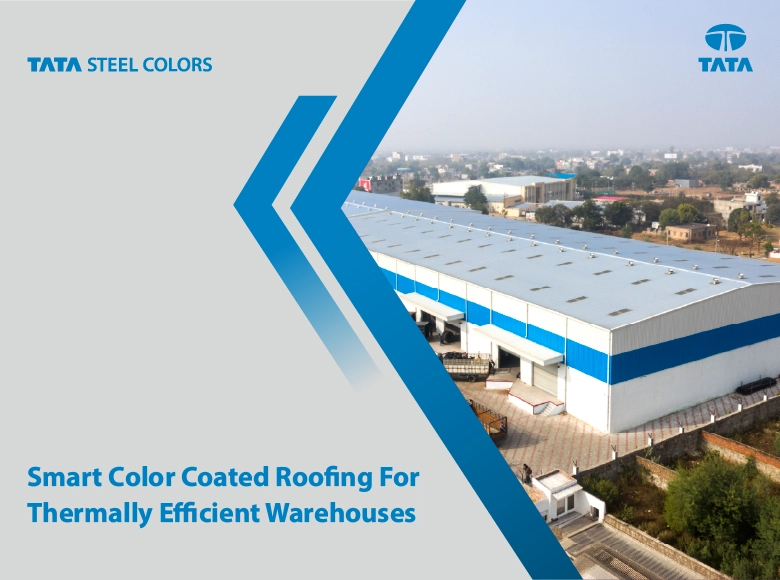
Thermal management is one of the most persistent challenges in industrial warehouses. Large roof areas, high internal volumes, limited insulation, and continuous exposure to solar radiation often result in elevated indoor temperatures. Excess heat affects worker comfort, equipment performance, and energy consumption, especially in facilities that rely on mechanical ventilation or cooling.
As warehouse design evolves, material selection for roofing and cladding has gained greater importance. Among the options available today, color-coated steel coils for warehouses are increasingly specified for their ability to manage heat gain while delivering durability and long-term performance. Understanding how these materials influence thermal behavior helps clarify whether they can effectively reduce building temperature in real-world conditions.
Why warehouses experience excessive heat buildup
Industrial warehouses typically feature wide, uninterrupted roof spans with minimal shading. During daylight hours, these roofs absorb a large amount of solar radiation. In conventional roofing systems, absorbed heat is transferred into the building interior, raising ambient temperatures throughout the storage and working areas.
Additional factors that contribute to heat buildup include:
- Limited roof insulation in cost-driven designs
- Low roof slopes that increase exposure duration
- Dark or low-reflectance roof surfaces
- High internal heat from equipment and material handling
In warm and tropical regions, these factors combine to create uncomfortable and sometimes unsafe working conditions. Reducing heat gain at the roof level is therefore one of the most effective strategies for improving thermal efficiency in warehouses.
What are color-coated steel coils and how are they used
Color-coated steel coils are manufactured by applying protective and reflective coatings to sheet steel coil under controlled factory conditions. The coated coil is then roll-formed into roofing or cladding profiles for use in industrial buildings.
Unlike basic painted sheets, color-coated steel is designed to deliver consistent coating thickness, strong adhesion, and predictable surface performance across large roof areas. This consistency is especially important in warehouses, where even minor variations in roof performance can have a noticeable impact on internal temperatures.
When used as roofing material, color-coated steel coils form the primary external surface that interacts with solar radiation.
Role of reflective coatings in reducing heat gain
One of the key ways color-coated steel coils help reduce building temperature is through their reflective surface properties. Heat reflective roof sheets are engineered to reflect a higher percentage of incoming solar radiation compared to conventional roofing materials.
By reflecting rather than absorbing heat, the roof surface remains cooler during peak daylight hours. This reduces the amount of heat transferred into the warehouse interior, directly lowering indoor air temperatures.
Thermal efficient roofing systems that incorporate reflective coatings are particularly effective in large warehouses, where roof area dominates the building envelope and solar exposure is continuous.
Impact on indoor thermal conditions
The reduction in roof surface temperature achieved through reflective color-coated steel can translate into measurable improvements inside the warehouse. Lower heat transfer through the roof helps stabilize internal temperatures and reduces temperature spikes during the hottest parts of the day.
Advanced color-coated steel coils help significantly reduce the baseline heat load entering the building. This makes other thermal management measures more effective and less energy-intensive.
For warehouses that rely on natural ventilation, lower roof heat gain can improve airflow efficiency and reduce heat accumulation near the ceiling.
Thermal performance over time
A key advantage of advanced color-coated steel is its ability to maintain thermal performance over extended service life. The coatings applied to sheet steel coil are formulated to resist ultraviolet degradation, chalking, and surface breakdown.
As a result, reflective properties are retained longer compared to basic painted surfaces, which may darken or degrade over time. Consistent reflectance ensures that heat reduction benefits remain effective year after year, supporting long-term thermal efficiency in warehouse operations.
This durability is an important consideration for facilities designed for decades of use with minimal maintenance disruption.
Relationship between roofing material and energy consumption
Reducing heat gain at the roof level has a direct influence on energy use. In warehouses equipped with mechanical ventilation or cooling systems, lower internal temperatures reduce the load on fans and cooling equipment.
Even in facilities without active cooling, improved thermal conditions can reduce the need for additional ventilation or localized cooling solutions. Over time, these efficiencies contribute to lower operational energy demand and more stable indoor environments.
From a lifecycle perspective, thermal efficient roofing supports cost control by addressing energy performance at the material level rather than relying solely on mechanical systems.
Integration with insulation and roof system design
It is important to note that the effectiveness of color-coated steel coils in reducing heat depends on how they are integrated into the overall roof system. Best results are achieved when reflective roofing is combined with appropriate insulation, ventilation strategies, and system detailing.
In such configurations, the color-coated roof surface limits heat entry, while insulation slows heat transfer and ventilation helps dissipate residual heat. Together, these elements form a balanced thermal management strategy suited for large industrial warehouses.
This system-based approach ensures that reflective roofing delivers consistent performance under varying climatic conditions.
Suitability for different warehouse applications
Color-coated steel coils for warehouses are suitable across a wide range of applications, including:
- Logistics and distribution centers
- Cold storage support buildings
- Manufacturing warehouses
- Agricultural and storage sheds
In each case, the ability to reduce building temperature contributes to improved working conditions, better protection of stored goods, and more efficient facility operation.
Warehouses located in high solar exposure regions benefit most from heat reflective roof sheets, particularly when the roof area is large relative to building height.
Limitations and realistic expectations
While color-coated steel roofing can significantly reduce heat gain, internal heat sources, poor ventilation, or inadequate insulation can still lead to elevated temperatures.
The role of color-coated steel is to reduce the external heat load entering the building. When combined with appropriate design measures, it forms a highly effective component of warehouse thermal management.
Setting realistic expectations ensures that material selection is aligned with overall building performance goals.
Conclusion: A practical approach to heat reduction in warehouses
So, can color-coated steel coils reduce heat inside industrial warehouses? The answer is yes, when used as part of a well-designed roofing system. By reflecting solar radiation, maintaining surface performance over time, and reducing heat transfer through the roof, color-coated steel plays a meaningful role in lowering indoor temperatures.
For developers, consultants, and facility managers seeking to reduce building temperature and improve thermal efficiency, color-coated steel coils for warehouses offer a practical, durable, and scalable solution. When paired with insulation and ventilation strategies, they support more comfortable working environments and improved operational efficiency across the life of the warehouse.
For more details, please get in touch with our team.