
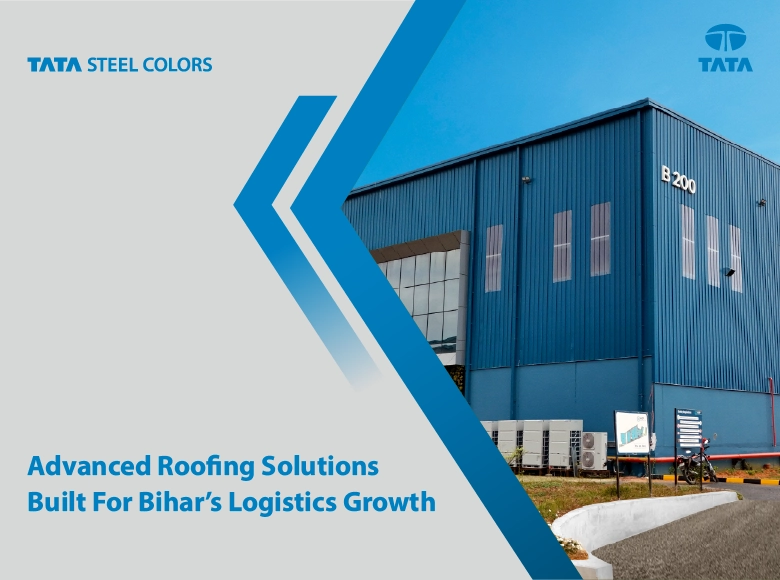
Bihar is rapidly emerging as an important warehousing and logistics destination in eastern India. Improved highway connectivity, proximity to consumption centers in eastern Uttar Pradesh, Jharkhand, West Bengal, and the Northeast, along with growing agricultural and FMCG distribution requirements, are driving the development of large storage and logistics facilities across Patna, Bihta, Muzaffarpur, Begusarai, Gaya, and industrial clusters along major transport corridors.
In this evolving landscape, roofing design plays a decisive role in determining storage efficiency, asset protection, and long-term operational reliability. Warehousing facilities depend heavily on durable, leak-proof, and low-maintenance roofing systems to safeguard goods and support uninterrupted logistics operations. Selecting the right warehouse roofing solutions is, therefore, a strategic decision rather than a purely construction-driven choice.
With India’s warehousing demand growing at 15–18% CAGR and eastern India accounting for an increasing share of agri-logistics and FMCG distribution, Bihar is seeing steady growth in Grade B and emerging Grade A warehouse development, particularly along NH-2, NH-31, and key freight corridors.
Warehousing conditions and roofing challenges in Bihar
Warehouses in Bihar operate under a mix of climatic and operational pressures. Summers are long and hot, with significant solar heat gain on large roof surfaces. The monsoon season brings heavy rainfall and high humidity, increasing the risk of water ingress and corrosion.
Summers are long and hot, with ambient temperatures frequently exceeding 40°C, resulting in roof surface temperatures that can go 15–20°C higher on exposed metal roofs. The monsoon season brings annual rainfall of 1,000–1,200 mm, often concentrated over a few months, increasing the risk of water ingress, corrosion, and humidity-related damage if roofing systems are not designed for high runoff volumes.
In agricultural storage and FMCG warehouses, dust control and moisture protection are critical to preventing inventory damage.
Additionally, modern logistics facilities demand large, column-free interiors and high clear heights to support mechanized racking, automated handling, and high stacking density. Long-span roofing systems can reduce internal columns by 20–30%, improving storage efficiency by up to 10–15% compared to conventional layouts, directly impacting revenue per square metre.
Roofing systems must therefore span large distances while maintaining structural stability and weather tightness.
These conditions make conventional roofing approaches insufficient for long-term performance. Purpose-designed industrial roofing sheets and system-based roofing solutions are better suited to address these challenges.
Key requirements for warehouse roofing solutions
Effective roofing for logistics and storage facilities must meet several performance benchmarks. First, the roof must provide reliable protection against rainwater ingress, even during intense monsoon events. Leak-proof performance is non-negotiable in warehousing, as even minor water leakage can damage stored goods and disrupt operations.
Industry estimates indicate that water leakage and moisture-related issues account for 25–30% of preventable warehouse inventory damage, particularly in agricultural produce, packaging materials, and FMCG storage.
Second, roofing systems must manage thermal behaviour. Large roof plates absorb significant heat, which can raise internal temperatures and affect both stored materials and worker comfort. Third, durability and corrosion resistance are essential, as frequent maintenance or roof access can interrupt operations and increase lifecycle costs.
Finally, warehouse roofs must support long spans and integrate easily with services such as lighting, ventilation, smoke extraction, and solar installations.
Industrial roofing sheets for warehouse applications
Industrial roofing sheets are designed to deliver structural strength, consistent coverage, and long-term durability under demanding conditions. For warehousing hubs in Bihar, industrial roofing sheets with adequate thickness and structural profile depth help achieve longer spans with fewer internal supports.
This improves internal layout flexibility and maximizes usable storage space. Properly designed sheets also contribute to effective water drainage by maintaining a consistent slope and alignment across large roof areas. Durability is another critical factor. Roofing sheets manufactured from corrosion-resistant steel substrates offer improved resistance to moisture, humidity, and environmental exposure.
This is particularly important in warehouses storing agricultural produce, chemicals, or packaged goods that require stable internal conditions.
Thermal performance and energy considerations
Although warehouses are not always air-conditioned, internal temperature control remains important for inventory protection and workforce productivity. Roofing systems that limit excessive heat ingress help maintain more stable internal conditions, particularly during peak summer months.
High-performance roofing solutions can be paired with insulation layers or reflective surfaces to reduce heat transfer into the warehouse. This supports energy efficiency by lowering reliance on mechanical ventilation and reducing internal heat buildup. For cold storage or temperature-sensitive warehousing, thermal performance becomes even more critical.
Studies across Indian industrial warehouses show that high-reflectance roofing and insulated systems can reduce internal temperatures by 4–8°C, improving worker comfort and reducing heat-related productivity loss. In facilities using ventilation or spot cooling, this can translate into energy savings of 8–12% over the building lifecycle.
Managing water and drainage effectively
Monsoon performance is a key consideration for warehouse roofing in Bihar. Large roof spans generate high volumes of runoff, which must be managed efficiently to prevent ponding or overflow.
For a typical 50,000 sq. m warehouse roof, a single heavy rainfall event can generate over 50,000 litres of runoff, making drainage design, slope consistency, and gutter detailing critical to preventing ponding and overflow.
Roofing solutions with well-defined drainage paths, adequate slope design, and compatible rainwater goods help maintain water tightness during heavy rainfall. Proper detailing at gutters, valleys, and roof-to-wall junctions reduces the risk of long-term leakage and structural deterioration.
Effective water management also protects wall systems and foundation zones, contributing to overall facility durability.
Durability and low maintenance as operational priorities
Warehousing facilities typically operate with minimal downtime, making frequent roof maintenance undesirable. Roofing solutions designed for durability reduce the frequency of inspections, repairs, and surface treatments.
Corrosion-resistant industrial roofing sheets maintain their structural and surface integrity over longer service periods, even in humid and polluted environments. Reduced maintenance requirements translate into lower lifecycle costs and fewer operational disruptions, which is especially valuable for third-party logistics operators managing multiple facilities.
Corrosion-resistant roofing systems can extend roof service life by 2–3 times compared to conventional painted sheets, while reducing maintenance interventions by 30–40% over the asset lifecycle.
Scalability and future expansion
Warehousing demand in Bihar is expected to grow steadily as logistics networks expand across eastern India. Roofing systems that support modular construction allow facilities to be extended or reconfigured with minimal disruption.
Warehouse roofing solutions designed with standard sheet dimensions and compatible accessories enable phased expansion while maintaining performance continuity. This flexibility supports long-term asset planning and reduces retrofit complexity.
Learning from established logistics markets
While Bihar is an emerging warehousing market, lessons from established logistics hubs across India highlight the importance of performance-led roofing design. Facilities that invest early in durable, system-based roofing solutions typically experience fewer operational issues and lower maintenance expenditure over time. Applying these best practices in Bihar helps developers future-proof warehouses and align with national logistics standards.
Conclusion: Choosing the right roofing solutions for Bihar’s warehouses
As Bihar strengthens its position as a logistics and warehousing hub, roofing decisions play a crucial role in determining the success and longevity of storage facilities. The right warehouse roofing solutions protect inventory, support efficient operations, and reduce long-term costs.
By selecting high-quality industrial roofing sheets and adopting system-based roofing for logistics and storage facilities, developers and operators can create warehouses that perform reliably under Bihar’s climatic and operational conditions.
For more details, please get in touch with our team.