
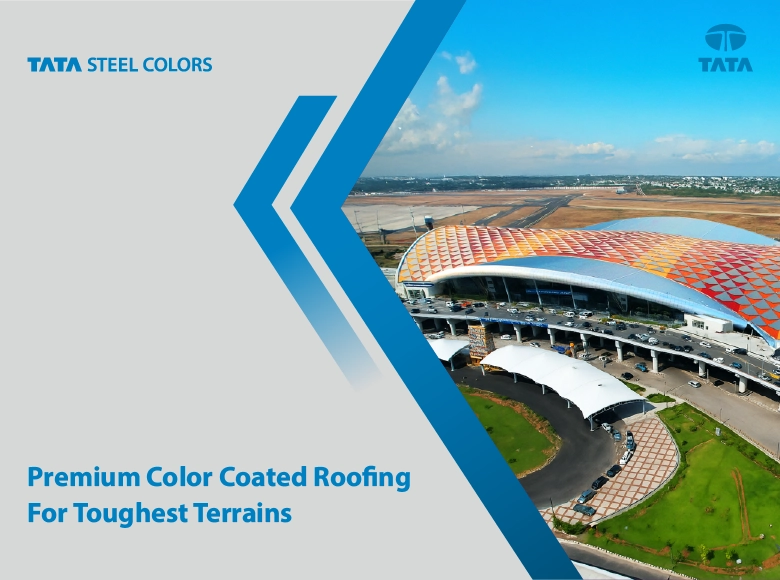
Infrastructure development in India’s North-Eastern region has gained strong momentum over the past decade. New airports, rail corridors, and transport-linked facilities are being planned and executed across Assam, Arunachal Pradesh, Meghalaya, Manipur, Mizoram, Nagaland, and Tripura. These projects play a critical role in improving connectivity, economic integration, and strategic mobility. However, building large-scale transport infrastructure in the North East presents a unique set of challenges that demand carefully selected materials and construction systems.
Among the most critical considerations are durability, corrosion resistance, and long-term performance of exposed building elements. Advanced color-coated steel coils have emerged as a key material choice for airport and rail projects in these remote terrains, where climatic severity, logistical constraints, and operational demands require infrastructure solutions that can perform reliably over extended service life.
Infrastructure challenges in the North Eastern Terrain
The geography of the North East is characterized by hilly landscapes, high rainfall, dense vegetation, and limited access routes. Infrastructure projects in the region often face prolonged monsoon seasons, high humidity, fog, and significant temperature variation between day and night. In several locations, airborne moisture and biological growth further accelerate material degradation.
For airport terminals, hangars, rail stations, depots, and associated structures, these conditions place intense stress on roofing and cladding systems. Conventional construction materials may struggle to deliver predictable performance under such exposure, leading to premature corrosion, leakage, and increased maintenance burden.
As a result, infrastructure planners increasingly prioritize materials that offer high corrosion resistance roofing performance while also supporting constructability in remote and logistically complex environments.
Airport construction steel requirements in remote regions
Airport infrastructure places strict demands on material performance. Roofs and façades must span large areas, accommodate complex architectural forms, and withstand continuous exposure to weather while supporting passenger comfort and safety.
Airport construction steel requirements in the North East extend beyond structural strength. Materials must resist corrosion caused by persistent moisture, withstand wind-driven rain, and maintain surface stability under prolonged ultraviolet exposure. In addition, airport facilities often operate continuously, making frequent maintenance interventions undesirable.
Advanced color-coated steel coils address these requirements by combining a corrosion-resistant metallic coating with a durable, factory-applied paint system. This layered protection helps safeguard airport roofing and wall systems against environmental degradation while supporting long service life with minimal intervention.
Rail infrastructure material needs in Assam and the wider region
Rail infrastructure expansion across Assam and neighboring states includes new stations, elevated corridors, workshops, and maintenance facilities. Rail infrastructure building materials in Assam must perform under heavy usage, vibration, and environmental exposure while ensuring operational safety.
Railway roofs and station buildings are particularly vulnerable to corrosion due to open layouts, large surface areas, and constant exposure to rainfall and humidity. High corrosion resistance roofing solutions are therefore essential to protect passenger areas, equipment zones, and structural elements.
Advanced color-coated steel coils provide consistent surface protection that reduces the risk of corrosion-related failures. Their predictable performance helps rail authorities maintain asset reliability while managing long-term maintenance costs across widely dispersed locations.
Importance of corrosion resistance in high-rainfall environments
Corrosion-resistant roofing is a defining requirement for infrastructure in the North East. Frequent wetting and drying cycles, combined with organic deposits from surrounding vegetation, create aggressive conditions for exposed steel surfaces.
Advanced color-coated steel coils slow down corrosion initiation by shielding the metallic coating from direct exposure to moisture and contaminants. The paint system acts as a barrier that reduces water penetration, while the underlying metallic layer provides sacrificial protection at vulnerable points such as cut edges and minor surface damage.
This dual protection mechanism makes such materials particularly suitable for high corrosion resistance roofing applications in airport and rail projects exposed to extreme climatic conditions.
Constructability and logistics in remote infrastructure projects
Remote infrastructure development often involves limited storage space, challenging transportation routes, and restricted construction windows. Materials that are factory-finished and ready for installation offer significant advantages in such scenarios.
Advanced color-coated steel coils support off-site fabrication and pre-engineered construction approaches, reducing the need for extensive on-site finishing. This improves construction speed, quality consistency, and safety, which are critical factors in remote airport and rail projects.
Reduced on-site painting and surface treatment also minimize dependence on weather conditions during construction, helping projects stay on schedule despite unpredictable regional climates.
Lifecycle performance and maintenance efficiency
Infrastructure assets in the North East are expected to serve for decades with limited access for frequent inspection or repair. High maintenance requirements can quickly escalate lifecycle costs and disrupt operations, especially in remote locations.
High-performance color-coated steel coils contribute to lower maintenance frequency by resisting corrosion, surface degradation, and coating failure. Stable performance over time supports predictable asset management and reduces the need for reactive repairs.
For airport terminals and rail stations that operate continuously, this reliability translates into improved passenger experience, operational continuity, and long-term cost efficiency.
Supporting architectural and functional requirements
Modern airport and rail projects increasingly emphasize architectural quality alongside functional performance. Roofs and façades are often designed with large spans, curved forms, and visually prominent surfaces.
Advanced color-coated steel coils offer good formability and surface consistency, supporting complex roof geometries and long sheet lengths without compromising coating integrity. This makes them suitable for infrastructure projects that require both aesthetic control and structural reliability. Consistent appearance over time also helps maintain the visual identity of transport hubs, which often serve as gateways to the region.
Conclusion: Building resilient transport infrastructure in the North East
Airport and rail projects in the remote terrains of the North East face some of the most demanding environmental and logistical conditions in the country. High rainfall, humidity, and limited access routes require infrastructure solutions that deliver reliable performance without frequent maintenance.
As infrastructure development continues to accelerate across the North East, investing in high-performance coated steel solutions will play a critical role in ensuring that airports and rail facilities remain safe, durable, and operationally efficient for the long term.
For more details, please get in touch with our team.