
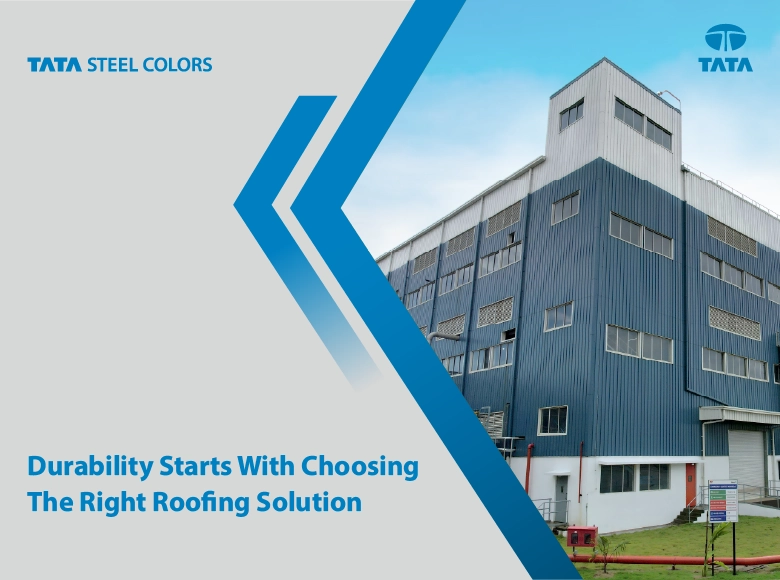
Industrial units across India operate in environments that place continuous stress on building infrastructure. Manufacturing plants, processing facilities, warehouses, and utility buildings are exposed to heat, humidity, dust, rainfall, chemical vapours, and mechanical activity on a daily basis. In such conditions, the durability of the building unit becomes a decisive factor in protecting operations, equipment, and workforce safety.
Roof and wall cladding solutions play a central role in this context. Far from being passive enclosures, modern industrial roof cladding systems and wall cladding assemblies function as engineered protection layers that determine how well an industrial unit withstands environmental exposure and operational wear over time.
Durability challenges in industrial buildings
Industrial buildings differ significantly from commercial or residential structures in both scale and usage. Large roof spans, high internal heat loads, vibration from machinery, and continuous movement of materials place sustained demands on roofs and walls.
In many industrial zones across India, additional challenges include high rainfall during monsoons, prolonged summer heat, airborne pollutants, and corrosive emissions, depending on the process involved. When building envelopes are not designed for these conditions, premature deterioration occurs in the form of corrosion, leakage, surface degradation, and structural fatigue.
These issues increase maintenance frequency, disrupt production schedules, and raise long-term operating costs. As a result, industrial building roofing in India increasingly relies on system-based cladding solutions rather than basic construction materials.
Role of industrial roof cladding systems in durability
Industrial roof cladding systems are designed to address multiple performance requirements simultaneously. Their primary function is to provide reliable weather protection, but their contribution to durability extends much further.
Well-engineered roof cladding systems manage wind uplift, thermal movement, and water drainage across large roof areas. By distributing loads efficiently and accommodating expansion and contraction, they reduce stress on individual components. This minimises the risk of cracking, joint separation, or fastener fatigue that commonly leads to early roof failure.
Additionally, modern roof cladding systems are designed to limit water stagnation and moisture retention. Effective drainage paths and controlled overlaps reduce the likelihood of corrosion initiating at vulnerable points, directly enhancing roof life.
Steel cladding for factories and long-term performance
Steel cladding for factories is widely adopted because of its strength, consistency, and predictable behaviour under load. When engineered correctly, steel cladding systems deliver long-term durability even in demanding industrial environments.
High-quality steel cladding resists deformation under wind and live loads, maintaining alignment and weather tightness over time. This is particularly important for factories with large roof spans, where even small deflections can affect drainage and increase leakage risk.
From a durability standpoint, steel cladding systems also offer superior resistance to impact and wear. In industrial settings where forklifts, cranes, or material handling equipment operate close to walls, robust wall cladding protects structural elements from accidental damage and surface deterioration.
Wall cladding as a protective barrier for industrial units
While roofing often receives primary attention, wall cladding plays an equally important role in enhancing industrial durability. Walls are continuously exposed to wind-driven rain, dust, pollutants, and in some cases, chemical splashes or vapours.
Modern wall cladding systems are engineered to provide structural stability and environmental protection without excessive thickness. They resist lateral wind loads and maintain surface integrity over long service periods. For industrial units handling sensitive processes, durable wall cladding also helps maintain controlled internal environments by reducing moisture ingress and dust penetration.
Steel cladding for factories is particularly effective in maintaining long-term wall performance, as it combines mechanical strength with resistance to environmental degradation.
Integrated roof and wall cladding solutions for consistent durability
The most durable industrial buildings use roof and wall cladding solutions as an integrated system rather than as isolated elements. When roofing and wall systems are designed to work together, performance becomes more predictable and weak points are minimised.
Integrated systems improve detailing at junctions, such as roof-to-wall interfaces, which are common sources of leakage and corrosion. Consistent material behaviour across roofs and walls also simplifies maintenance planning and reduces variability in long-term performance.
For large industrial campuses or multi-bay factories, this system-based approach ensures uniform durability across the entire facility rather than selective performance in isolated zones.
Resistance to corrosion and environmental exposure
Corrosion is one of the most significant threats to durability in industrial buildings. Moisture, pollutants, and chemical exposure accelerate material degradation if protective systems are inadequate.
Modern industrial roof cladding systems and wall cladding solutions are manufactured with corrosion-resistant substrates and protective coatings that slow down oxidation and surface breakdown. These features protect vulnerable areas such as cut edges, fastener zones, and overlaps, which are typical failure points in conventional construction.
Reduced maintenance and lifecycle cost benefits
Durability and maintenance are closely linked. Buildings that require frequent repairs or surface treatment incur higher lifecycle costs and greater operational disruption.
Roof and wall cladding solutions designed for durability reduce maintenance frequency by maintaining structural and surface integrity over extended periods. This is particularly valuable in industrial units where roof access involves safety protocols, production shutdowns, and specialised equipment. Lower maintenance demand reduces direct repair costs, improves asset predictability and simplifies long-term facility management.
Adaptability and future-proofing industrial units
Industrial facilities are rarely static. Changes in production capacity, process upgrades, and expansion plans are common over the life of a plant. Durable cladding systems support this adaptability by providing stable substrates that can accommodate modifications without widespread replacement.
Steel cladding for factories allows for controlled removal and replacement of panels, making it easier to integrate new services, extensions, or structural changes while preserving overall durability. This adaptability further enhances the long-term value of industrial buildings and supports phased growth strategies.
Conclusion: Durability through engineered cladding systems
Durability in industrial units is achieved through material selection as well as through well-engineered roof and wall cladding solutions that address environmental exposure, structural behaviour, and operational demands.
Industrial roof cladding systems, combined with robust wall cladding assemblies, protect factories from weather, corrosion, and mechanical stress while reducing maintenance and lifecycle costs. Steel cladding for factories provides the strength, consistency, and long-term reliability required for demanding industrial applications.
As industrial building roofing in India continues to evolve, adopting integrated, performance-driven cladding solutions has become essential for creating facilities that remain reliable, safe, and cost-efficient over decades of operation. To know more about the significance of roof and wall cladding systems for industrial units, please get in touch with our team.